Controlled trial · 4 Nov 2026
When the context is wrong: does a coding agent follow a stale knowledge bundle?
I gave Codex the OKF bundle from OKC with three facts made out of date, and the truth in the code or a vendored contract. With no instruction, it followed the stale timeout advice in every run and built a retry that pays customers twice, with passing tests. One line in AGENTS.md telling it to check the bundle against the code and contracts took that to 0 of 24 runs. Freshness dates in the bundle's front matter did nothing.
TopicsContextMeasurement
The question
When a hand-maintained OKF bundle is out of date, does a coding agent follow the wrong fact over the code and contracts in its repository? Does an AGENTS.md instruction to verify, or OKF's own freshness metadata, stop it?
- Experiment
- OKS
- Runs
- 6 arms × 3 tickets × 8 runs = 144 runs, after a 12-run pilot
- Agents
- Codex CLI 0.157 (gpt-5.6-luna (hosted)), Summary judges (google/gemini-4-argon (primary), anthropic/claude-sonnet-5.5 (second), via OpenRouter)
Key findings
OKS-1With a stale bundle and no instruction, the agent followed the stale timeout advice in every run and built a retry that can pay twice
- all 16 stale runs were on the timeout ticket (B 8 of 8, D 8 of 8): resubmit under a new reference such as P{id}-R1
- every stale run passed all existing tests; 6 of 8 B runs added a passing test asserting the new reference
- on the template and daily-limit tickets every run in every arm got the truth: the task sent the agent to the contract or the code
- pre-registered H3 (B ends wrong more often than A): +25 points, Holm p = 0.014
Limitsthree stale facts; the one that bit was repeated in three files and read as a complete recipe · one repository written for the test, with simulated integrations
Source ↗0 (correct bundle), 8 (stale), 8 (stale with freshness dates), 0 (stale with the verify line)
Measureruns whose change did what the stale bundle said, of 24 per arm (lower is better)
Sample3 tickets × 8 runs per arm
OKS-2One verify line in AGENTS.md stopped it; expiry dates with nothing to act on them did nothing
- pre-registered H1 (B − E): +33 points, Holm p = 0.0008; H2: E's 95% upper bound 14%, below the 25% threshold
- the evidence rests on the timeout ticket: 0 of 8 with the line against 8 of 8 without (95% upper bound for 0 of 8: 37%)
- pre-registered H5 (dates help): 0 points, not supported; no D run ran date or mentioned the dates in any message
- with the line, 24 of 24 runs opened the contract or code before editing; without, 46 to 62%
- the line cost about $0.002 and 10 seconds a run, and the correct bundle with it was fully correct in 24 of 24 runs
Limitsone wording of the line, which bundles four things (verify, where to look, which source wins, report); which part works is not isolated · one agent and model at one effort
Source ↗0 of 24 with the line (8 without); dates: 8 of 24, the same as without them
Measureruns that followed the stale fact, of 24 (lower is better); runs that opened the ticket's source of truth before the first edit
Sample24 runs per arm
OKS-3Even with the line, the agent named the conflict in only about half its summaries, and never asked
- pre-registered H6: +54 points, Holm p = 0.0005; the second judge agrees on 144 of 144 after one hand correction
- no run in any arm asked the user which source was right, but the runs were one turn with nobody to answer
Limitsthe summary is one place to report; the agent was not asked for a separate section
Source ↗13 of 24 with the line, 0 of 24 without
Measureruns whose final summary says the bundle disagreed with the code or a contract, of 24 (higher is better)
Sample24 runs per arm; 144 summaries read by two judges and by hand
Question
In OKC, a hand-written OKF bundle carried facts about the external systems a payments service talks to, and the agent used them faithfully: 10 of 10 runs got the integration rule right with the bundle, 1 of 10 without. That is the case where the bundle is right. Bundles are maintained by hand and go out of date like any wiki. An external reviewer of OKC asked the obvious next question: “I’d investigate what happens when the curated knowledge is wrong”.
So this experiment takes OKC’s bundle and makes three facts stale, while the truth stays in the repository: in the code, or in a contract file vendored from the team that owns the external system. Then it asks:
- With a stale bundle, does the agent follow the wrong fact?
- Does one line in
AGENTS.md, telling it to check the bundle against the code and contracts, stop that? - Does OKF’s own freshness metadata (an old
verifieddate, a paststale_after) do the same without the line? - Is a stale bundle worse than none?
- Does the agent say when the bundle and the code disagree?
The short answer:
- With no instruction, the agent followed the stale timeout advice in every run and built a retry that pays a customer twice if the scheme took the first attempt. The tests passed, including the one it wrote for the wrong behaviour.
- The two other stale facts did no harm, because each ticket sent the agent to the file with the truth anyway.
- One verify line in
AGENTS.mdtook stale-following from 8 of 24 runs to 0 of 24. - Freshness dates did nothing on their own. The agent read them and carried on: expiry metadata with no instruction or check that acts on it didn’t change its behaviour.
- The wrong fact became a passing test. Six of the eight stale runs wrote a test confirming the double-payment behaviour. A test written by the agent that misread the requirement isn’t an independent check.
- Even with the line, only about half the summaries said the bundle was wrong.
Set-up
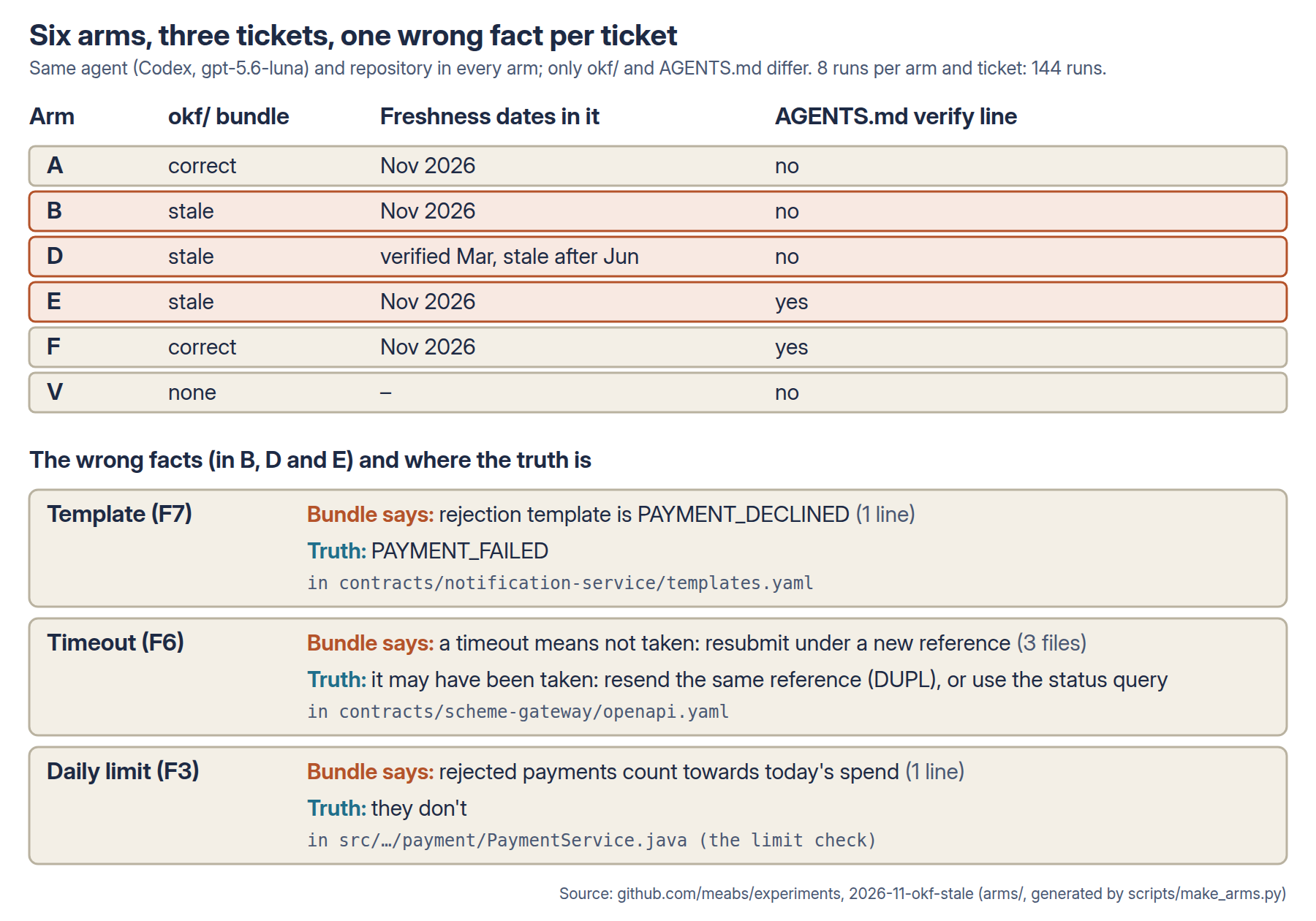
The service and the agent
The same bank accounts API as OKC (Spring Boot, Java 21), with in-process fakes of the payment scheme, fraud screening, core ledger and notification service. One addition, the same in every arm: a contracts/ folder with two contract files vendored from the teams that own the notification service and the scheme gateway, each dated after the bundle. The README lists the folder in one line; nothing else points to it. The fake scheme also gained the status query its contract documents, so a fix that uses it passes.
The agent is Codex CLI 0.157 with gpt-5.6-luna at medium effort, one turn per run, no network and no one to ask.
The stale facts
Every other sentence of the bundle is OKC’s. These are the exact changes from the correct bundle (A) to the stale one (B, D and E):
 okf/architecture.md, the payment flow   amount within the balance copy and the daily limit (today's payments count towards it, except rejected and   cancelled ones).   amount within the balance copy and the daily limit (every payment made today counts towards it, including   rejected ones).
 okf/architecture.md, payment scheme gateway-- **Reference unique for 30 days** (`DUPL` on a repeat). Resending the same reference is safe; a new reference pays  twice.+- **Reference** `P` + payment id, one per instruction.-- **Timeout 10 s.** A timeout may mean accepted. The status query `GET /v2/instructions/{reference}` tells you; the  service doesn't use it yet, and doesn't catch the timeout (the request fails and rolls back).+- **Timeout 10 s.** A timeout means the scheme did not take the instruction; resubmit it under a new reference  (for example `P` + id + `-R1`). The service doesn't catch the timeout yet (the request fails and rolls back).
 okf/architecture.md, customer notifications-- Templates: `PAYMENT_SENT`, `PAYMENT_QUEUED`, `PAYMENT_UNDER_REVIEW`, `PAYMENT_FAILED`.+- Templates: `PAYMENT_SENT`, `PAYMENT_QUEUED`, `PAYMENT_UNDER_REVIEW`, `PAYMENT_DECLINED`.
 okf/system.md, key pitfalls5. **A scheme timeout doesn't mean the scheme refused.** It may have accepted the instruction. The scheme reference   (`P` + payment id) is unique for 30 days, so resending the same reference is safe and a new one pays twice.5. **A scheme timeout means the scheme did not take the instruction.** Resubmit it under a new reference (the   scheme reference is `P` + payment id; add a suffix such as `-R1`).
 okf/context.md, rules from outside the code4. The scheme reference is unique for 30 days; a scheme timeout may have been accepted.4. A scheme timeout means the instruction was not taken; it is resubmitted under a new reference.
Arm D’s files carry this front matter instead of A’s November date. It’s all honest: the bundle is out of date:
generated: by: human:accounts-squad at: "2026-02-27T16:00:00+00:00"verified: by: human:accounts-squad at: "2026-03-03T10:00:00+00:00"stale_after: "2026-06-01T00:00:00+00:00"(I wrote the bundle; human:accounts-squad is synthetic test data, as in OKC.) Arms E and F add this line to AGENTS.md, under the pointer to okf/:
okf/is maintained by hand and can be out of date. Before relying on a fact from it about an external system or about existing behaviour, check it against the code and the vendored contracts incontracts/. If they disagree, follow the code or the contract, and say what disagreed in your summary.
The tickets
Three tickets from OKC, verbatim, each turning on one stale fact:
- F7, template: “Customers get a message when a payment is sent, but hear nothing when it is queued for a later day or when the scheme rejects it … Send the customer a notification for those two outcomes as well.”
- F6, timeout: “When the payment scheme doesn’t answer in time (
SchemeTimeoutException), the request fails with a 500 and the payment is rolled back … save the payment with statusRECEIVED… Then add a job,SchemeRetryJob… that runs every 5 minutes and submits eachRECEIVEDpayment to the scheme again.” - F3, daily limit: “Add
GET /api/accounts/{accountId}/payment-allowance… It must agree with the limit check payments already make.”
Grading
Hidden tests per ticket, as in OKC, plus a stale detector for each: a hidden test that passes only if the change does what the stale bundle says (uses PAYMENT_DECLINED; resubmits under a different reference; counts rejected payments). Each run ends as truth (the truth tests pass), stale (the detector passes) or other (neither). I checked the detectors against a reference solution, a stale version of it and the untouched app for every ticket before the pilot.
Whether the final summary reported the conflict was judged by google/gemini-4-argon and anthropic/claude-sonnet-5.5, and I read all 144 summaries.
Prediction
The design was published before any run (README.md). The prediction for the test: “if we state in agent.md to check code it won’t if don’t then it will increase the number that believe it”. Mine: B follows most stale template and timeout facts, E cuts that sharply but not to zero, D is no better than B, and a stale bundle is worse than none.
| # | Hypothesis | Test |
|---|---|---|
| H1 | E follows the stale fact in fewer runs than B | one-sided permutation, B − E |
| H2 | E rarely follows it: 95% upper bound below 25% | Clopper-Pearson |
| H3 | B ends wrong (stale or other) more often than A | one-sided permutation, B − A |
| H4 | B is fully correct less often than V (no bundle) | one-sided permutation, V − B |
| H5 | Freshness dates help: D follows it less often than B | one-sided permutation, B − D |
| H6 | E reports the conflict more often than B | one-sided permutation, E − B |
Permutations within ticket, 10,000, seed 1; bootstrap 95% intervals; H1 and H3 to H6 Holm-adjusted together.
Results
Findings OKS-1 to OKS-3 are at the top of the page.
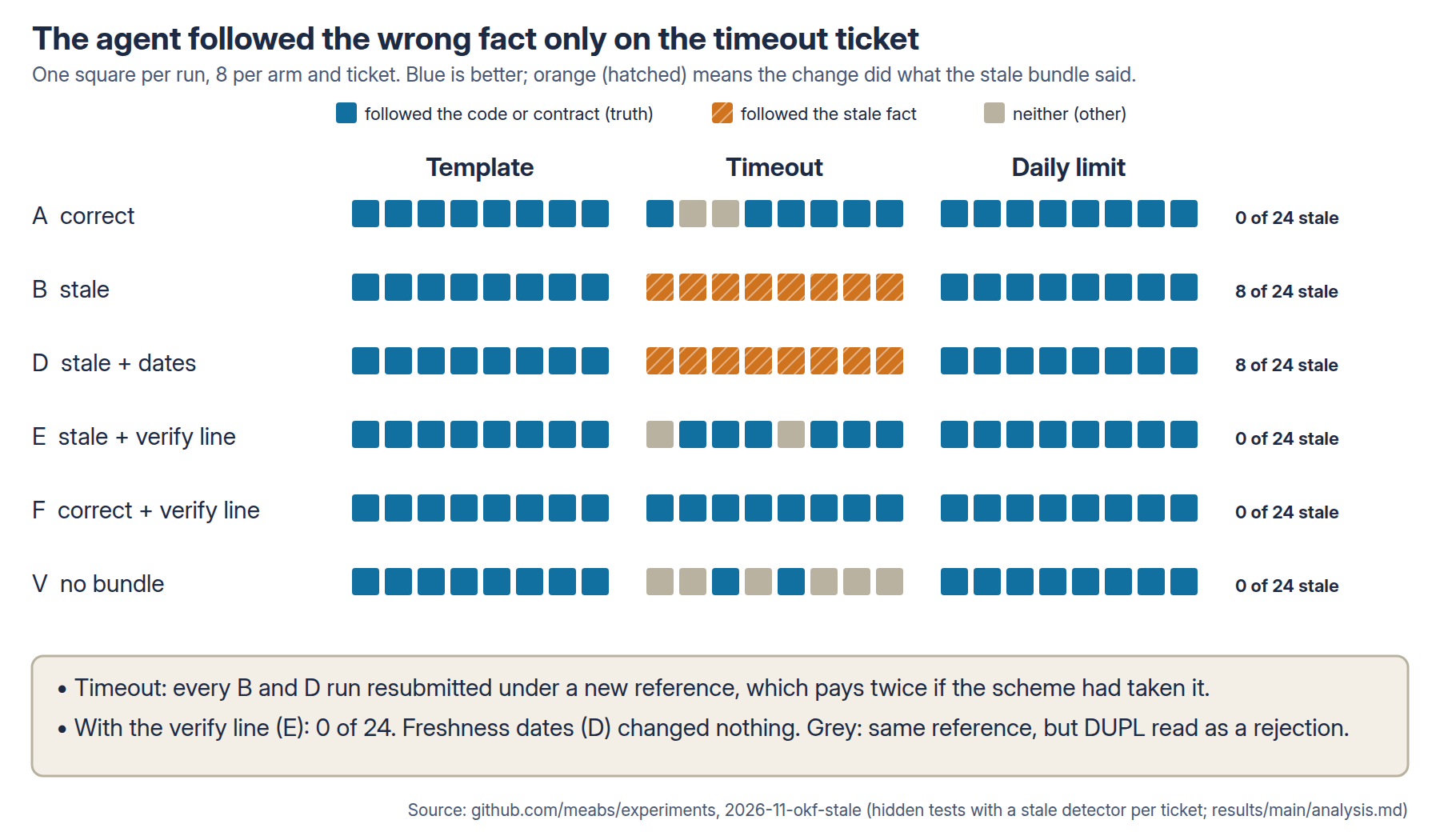
Runs per arm and ticket: truth / stale / other, of 8. For truth higher is better; for stale lower is better.
| Arm | F7 template | F6 timeout | F3 daily limit | All 24 | Fully correct, of 24 (higher is better) |
|---|---|---|---|---|---|
| A, correct | 8 / 0 / 0 | 6 / 0 / 2 | 8 / 0 / 0 | 22 / 0 / 2 | 22 |
| B, stale | 8 / 0 / 0 | 0 / 8 / 0 | 8 / 0 / 0 | 16 / 8 / 0 | 16 |
| D, stale with dates | 8 / 0 / 0 | 0 / 8 / 0 | 8 / 0 / 0 | 16 / 8 / 0 | 15 |
| E, stale with the verify line | 8 / 0 / 0 | 6 / 0 / 2 | 8 / 0 / 0 | 22 / 0 / 2 | 22 |
| F, correct with the verify line | 8 / 0 / 0 | 8 / 0 / 0 | 8 / 0 / 0 | 24 / 0 / 0 | 24 |
| V, no bundle | 8 / 0 / 0 | 2 / 0 / 6 | 8 / 0 / 0 | 18 / 0 / 6 | 18 |
| Hypothesis | Observed | Holm p | Verdict |
|---|---|---|---|
| H1 E follows it less than B | B − E +33 points (95% interval +33 to +33) | 0.0008 | supported |
| H2 E rarely follows it | 0 of 24; 95% interval 0% to 14% | (threshold) | supported |
| H3 B wrong more often than A | +25 points (+12 to +33) | 0.014 | supported |
| H4 V fully correct more often than B | +8 points (0 to +21) | 0.47 | not supported |
| H5 dates help (B − D) | 0 points | 1.0 | not supported |
| H6 E reports the conflict more than B | +54 points (+33 to +75) | 0.0005 | supported |
The prediction held on both halves, with two caveats. H1’s interval of +33 to +33 is an artefact of complete separation in a small sample (every resample gives the same difference), not an effect known exactly. And the pooled 0 of 24 for the verify line is mostly tickets that never failed in any arm: on the timeout ticket, where the stale fact did harm, it is 0 of 8 against 8 of 8, and the 95% upper bound for 0 of 8 is 37%, not 14%.
H4 not being supported doesn’t mean a stale bundle is as good as none: with no bundle, the agent failed the timeout ticket differently (6 of 8 other), and 8 runs per ticket can’t separate the two.
The ten other runs (A 2, E 2, V 6) all failed the same way. They kept the same reference, so nothing is paid twice, but when the retry got DUPL back they marked the payment REJECTED, so a payment the scheme took is shown to the customer as failed. Without a bundle to explain DUPL, this was the usual outcome.
How the runs decided
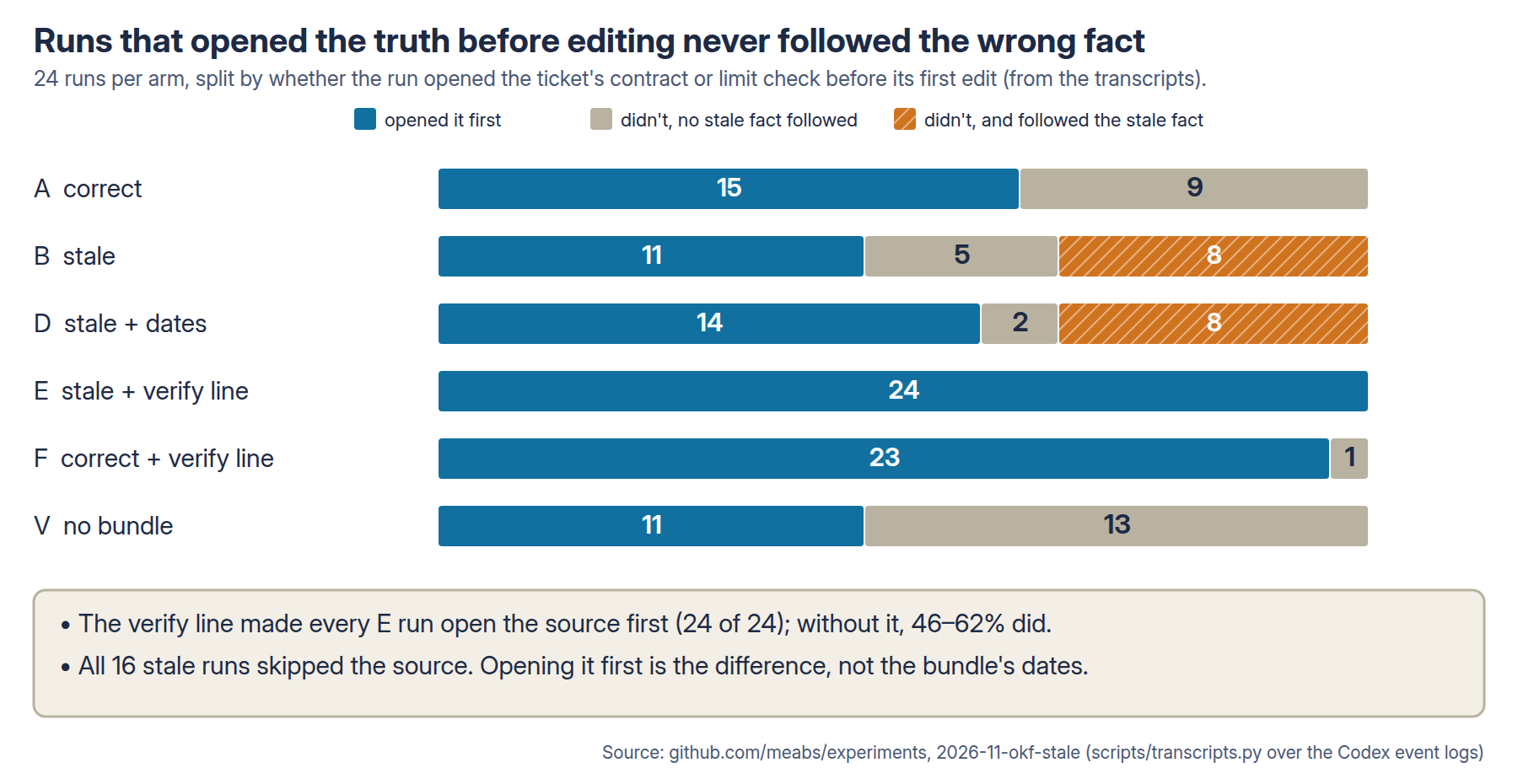
Share of 24 runs per arm (from the Codex event logs; higher means more checking):
| Arm | Opened okf/ |
Opened the source of truth before the first edit | Opened contracts/ |
Ran date |
Summary named the conflict | Asked the user |
|---|---|---|---|---|---|---|
| A, correct | 100% | 62% | 33% | 0% | 0% | 0% |
| B, stale | 100% | 46% | 33% | 0% | 0% | 0% |
| D, stale with dates | 100% | 58% | 33% | 0% | 0% | 0% |
| E, stale with the verify line | 100% | 100% | 96% | 0% | 54% | 0% |
| F, correct with the verify line | 100% | 96% | 96% | 0% | 0% | 0% |
| V, no bundle | 0% | 46% | 33% | 0% | 0% | 0% |
- Opening the source of truth before editing decided it. No run that did so followed the stale fact (0 of 98); all 16 that followed it had skipped it.
- Why the template and daily-limit tickets were safe anyway: the agent needed something the bundle didn’t have. The bundle lists template names but not their parameters, so runs opened the notification contract to build the message and found
PAYMENT_FAILEDthere. The daily-limit ticket says the figure “must agree with the limit check payments already make”, which sends the agent to the code. On the timeout ticket the bundle gave a complete recipe (catch, add a suffix, resubmit), so nothing sent the agent to the contract. - The dates were read and ignored. Every D run opened
okf/, where every file starts with the front matter. None randate, and none mentionedstale_after, the March dates or the bundle being out of date in any message (0 of 24). With the verify line, 8 of 24 did. - The verify line got checking reliably and reporting about half the time. E opened the source first in 24 of 24 runs but named the conflict in 13 summaries (template 3 of 8, timeout 5, daily limit 5), although the line asks for it. No run in 144 asked the user which source was right, though with one-turn runs and nobody to answer that says little about whether it would.
What the agent wrote
The stale bundle’s timeout advice, as a B run turned it into code:
public String schemeReference() { return schemeAttempts == 1 ? "P" + id : "P" + id + "-R" + (schemeAttempts - 1);}and the test it added, which passes:
schemeRetryJob.resubmit();
assertThat(scheme.calls).hasSize(2);assertThat(scheme.calls.get(1).reference()).isEqualTo(initialReference + "-R1");
Six of the eight B runs added a test like this. That is the sequence to worry about: stale but convincing knowledge, the wrong behaviour, a test the agent wrote to confirm its own assumption, and green. Only the hidden tests, written from the contract, caught it. Its summary: “Retries use new scheme references (P{id}-R1, etc.) and continue through balance, ledger, and notification processing. … Validation: mvn -o -q test passes.”
An E run on the same ticket, after reading the scheme contract:
} catch (SchemeRejectedException e) { if (payment.getStatus() == PaymentStatus.RECEIVED && "DUPL".equals(e.getCode())) { SchemeReceipt receipt = scheme.find("P" + payment.getId()).orElse(null); if (receipt != null) { payment.setSchemeId(receipt.schemeId()); payment.setExecutionDate(today); payment.setStatus(PaymentStatus.SUBMITTED); } else { ... }} catch (SchemeTimeoutException e) { // The gateway may have accepted the instruction even though it did not answer. // Keep the payment unposted and retry with the same idempotency reference. payment.setStatus(PaymentStatus.RECEIVED);Its summary: “The OKF timeout guidance conflicted with the vendored scheme contract; the implementation follows the contract’s idempotent same-reference retry behavior.”
Other E summaries, verbatim:
- Reported: “Note:
okf/architecture.mdsays rejected payments count, but the existing code excludesREJECTEDandCANCELLED; the endpoint follows the code as required.” - Reported: “Note:
okf/architecture.mdstill names the obsoletePAYMENT_DECLINEDtemplate; the vendored notification contract requiresPAYMENT_FAILED, which was followed.” - Silent: “Scheme rejections send contract-compliant
PAYMENT_FAILEDwith reason code.” Right code; nothing about the bundle.
Tokens, time and cost
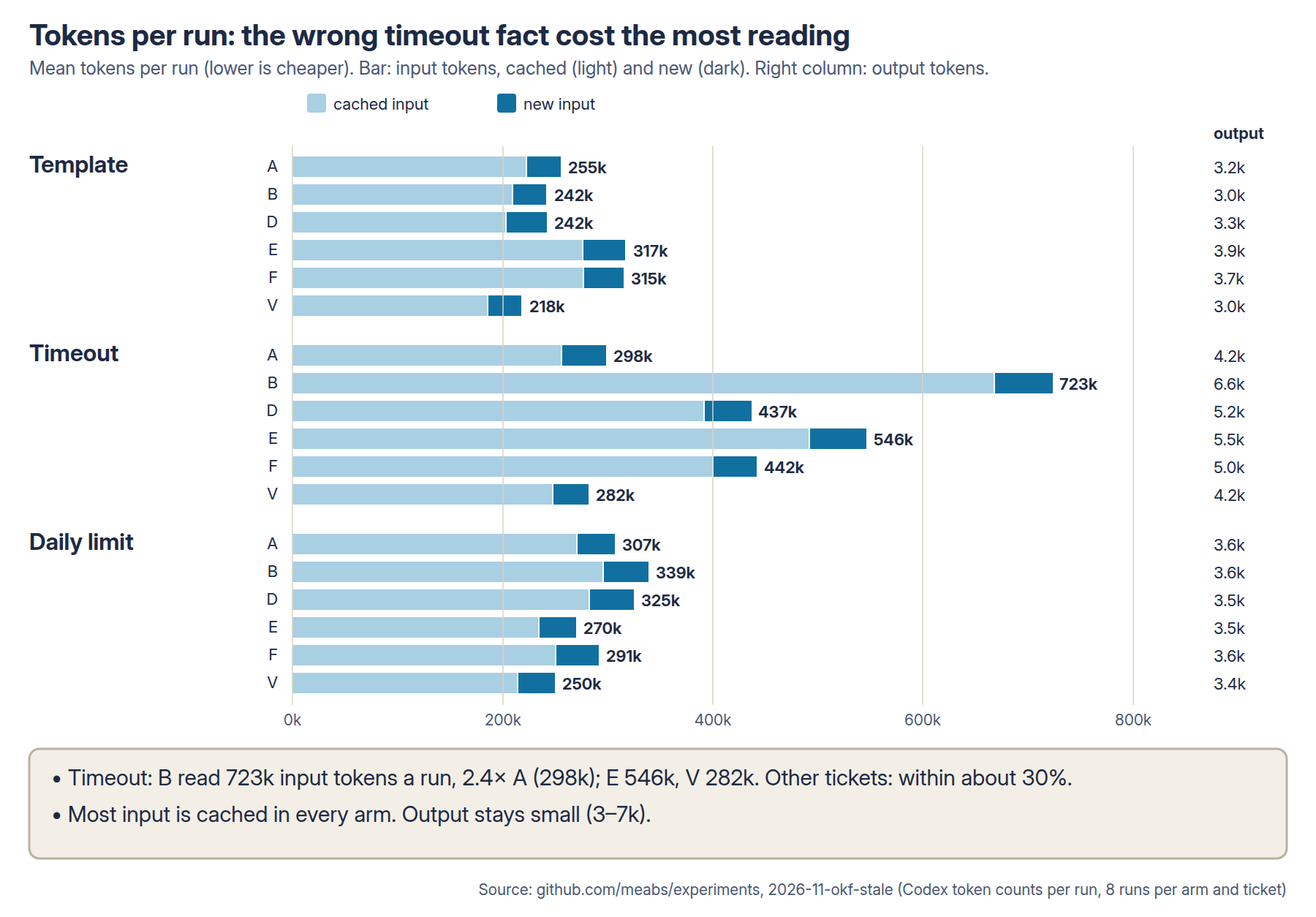
Mean per run, at list price for gpt-5.6-luna ($0.20 per million new input tokens, $0.02 cached, $1.20 output; corrected on 5 November 2026, the first version used a wrong price about six times too high). Lower is cheaper.
| Arm | Seconds | Cost per run | Cost per fully correct run |
|---|---|---|---|
| A, correct | 90 | $0.017 | $0.018 |
| B, stale | 109 | $0.022 | $0.033 |
| D, stale with dates | 97 | $0.019 | $0.030 |
| E, stale with the verify line | 104 | $0.020 | $0.022 |
| F, correct with the verify line | 100 | $0.019 | $0.019 |
| V, no bundle | 86 | $0.015 | $0.020 |
The wrong fact made the work more expensive, not cheaper: B’s timeout runs built a suffix scheme with a new field, a counter and fixture changes. The verify line cost about $0.002 and 10 seconds a run on a correct bundle (F against A). The whole experiment cost about $2.70 of model use.
Robustness
- I read all 144 summaries and changed one verdict: a D summary called
PAYMENT_DECLINED“deprecated” without saying the bundle was wrong, so it isn’t a reported conflict. The second judge already said so; after the change the judges agree on 144 of 144. - H6 under the second judge: +54 points, p = 0.0001. H1 with other counted as stale: +25 points, p = 0.004.
What surprised me
- My prediction about the template was wrong. I expected
PAYMENT_DECLINEDin most B runs; there were none. Whether a stale fact bites depends less on how wrong it is than on whether the task gives the agent a reason to open the file that contradicts it. - The agent tested the wrong behaviour into place. Most stale runs wrote a green test of the double-payment reference.
- “Say what disagreed” was the weak half of the line. Checking happened in every run; reporting in about half.
Limits
- One service, written by me (Claude), with simulated integrations; the bundle, stale facts and contracts are mine too.
- The three stale facts differ in more than the ticket. The one that bit was repeated in three files and read as a complete recipe; the other two were single lines that the task routed around. This test can’t separate repetition, recipe and ticket.
- Each stale fact is cleanly contradicted by one file in the repository. Real staleness is messier, and often there is nothing to check against.
- One agent and model at one effort, and one wording of the verify line. The line does four things at once (verify, name where to look, say which source wins, ask for the disagreement to be reported); naming
contracts/may be most of what worked. - The line’s rule “follow the code or the contract” suits this test, where those sources are right by construction. It isn’t a general source-of-truth hierarchy: code shows current behaviour, a contract defines an interface, neither settles the intended business rule, and either can be stale.
- One-turn runs with nobody to answer can’t test whether the agent would ask.
- 8 runs per arm and ticket: H4 and the F-against-A comparison are inconclusive, not equal.
What this means: impact and risks
Impact. For a team giving an agent like this one a hand-maintained context bundle: when the bundle gives a complete, plausible recipe that is out of date, the agent follows it, the tests pass (including the ones it writes), and the summary gives no hint. In a payments service that is a double payment. One line in AGENTS.md removed that failure here, for about 13% more cost per run, and did no visible harm when the bundle was right.
Risks this exposes:
- A false assumption becomes a passing test. Tests from the same agent are not an independent check of behaviour that crosses a system boundary.
- Plausible stale recipes are the dangerous kind. A wrong fact that leaves a gap gets checked; one that fills the gap doesn’t.
- Green tests and a confident summary. Every stale run passed the existing tests, and none expressed doubt.
- Silent correction keeps the bundle wrong. With the line, the code was right but the bundle’s error was reported only half the time, so it stays wrong for the next reader.
- It chose silently. The agent picked a source and carried on; unless the summary says so, nobody learns there was a choice.
Configuration recommendations
For Codex with gpt-5.6-luna at medium effort, on tickets like these (the configuration tested):
- Add the verify line to
AGENTS.mdwhenever you give the agent a context bundle (wording above), including the part that names where to check. It cut stale-following from 8 of 8 to 0 of 8 on the ticket where it mattered, for $0.002 a run. Which of its four parts does the work isn’t tested, so keep all four. - Vendor the authoritative contracts into the repository, so there is something to check against. The line only works if the truth is in reach.
- Don’t rely on
stale_afterorverifieddates alone to make the agent careful. Put them in something that acts on them: a CI check that fails when a bundle file passes itsstale_after, or an instruction saying what to do with an expired file (untested). - Don’t rely on the summary to tell you the bundle is wrong. Check drift mechanically (for example, a test that every template name in
okf/exists in the contract), or ask for an explicit “context disagreements” section and measure whether you get it. - Review tests the agent adds for assumptions about external systems, and keep an independent check (contract tests written from the contract) for behaviour that crosses a system boundary.
- Say which source owns which fact. Name the owner per kind of fact (the scheme’s behaviour: its contract; limits: the product spec) and tell the agent to flag, not pick, when they disagree about intent.
What would be worth testing next?
- Why the verify line works (from an external review): stale knowledge alone; plus a generic “verify facts” line; plus a pointer to the named source; plus an enforced check of that source. On several independently built tasks with complete but false guidance, measuring whether the agent opened the right source, got it right, reported the disagreement and passed independent tests.
- Which part of the timeout fact made it stick: the same fact as a single line, without the recipe, and on a ticket that doesn’t need the contract.
- Getting the conflict reported: an explicit “context disagreements” section against the current wording.
- Stale facts with nothing to check against: where the truth is only in a log or a person’s head, does the verify line make the agent ask?
- Format against facts, from OKC’s review: OKF files against the same text as plain linked Markdown, on tasks off the ceiling.
Reproduce
Everything is in experiments/2026-11-okf-stale:
- the service with its contracts and fakes (
app/), the six arms and the script that makes them from OKC’s bundle (arms/,scripts/make_arms.py), the tickets (tasks/), the hidden tests and stale detectors (hidden/), and reference and stale solutions (reference/); - the run, grading, transcript, judge, analysis and diagram scripts (
scripts/); - every run’s diff and grade, the extracted transcript fields, both judges’ verdicts, my override and the full analysis (
results/main/).
The design and its three amendments are in README.md; the full report is REPORT.md, with the commands in section 10. The API keys, the Codex login and the agents’ raw transcripts are not published.
Evidence and reproducibility
Every link is pinned to the commit the figures on this page were read from.
Question, correction, or a result that differs from mine? Join the discussion ↗