Controlled trial · 21 Oct 2026
Skill packs across 16 tasks
Two popular skill packs for coding agents did not reliably make the agent's changes more correct; one cost about three times as much.
The question
On a varied set of real change tasks, do Superpowers or Matt Pocock's skills raise the share of changes that pass independent acceptance tests, and at what cost in tokens?
- Experiment
- SKT
- Runs
- 128
- Agents
- Codex (gpt-5.6-luna)
Key findings
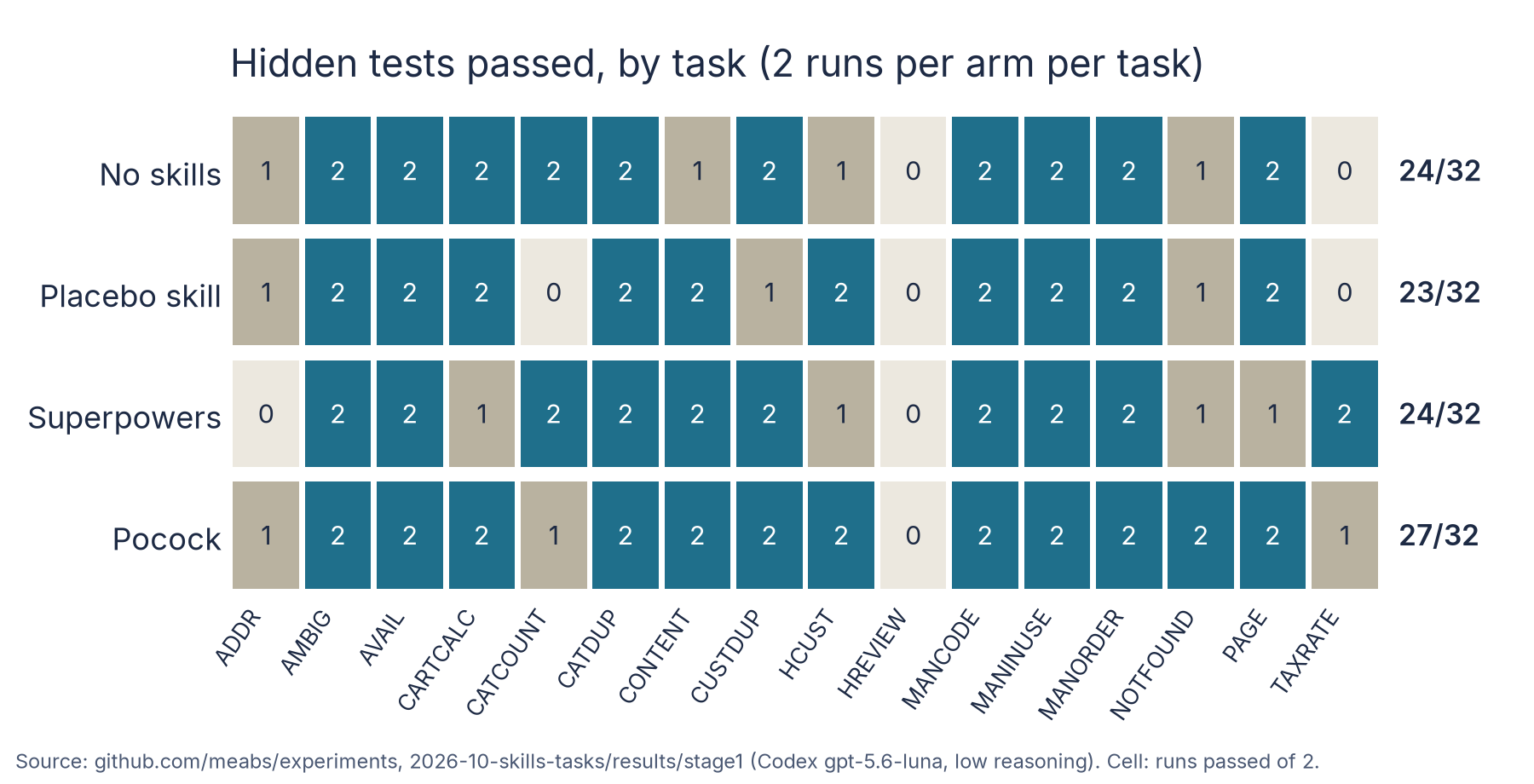
SKT-1Neither skill pack reliably raised the pass rate: Superpowers passed 24 of 32 runs, the same as with no skills, and Pocock passed 27 of 32, a gap small enough to be chance (Holm p = 0.38)
Limitsone repository · one model at low reasoning effort · 16 tasks, 2 runs per task per arm
Source ↗+9.4 pts
Interval includes zero
95% interval −3.1 pts to +21.9 ptsbootstrap 95% CI over 16 tasks
MeasurePocock vs no skills, mean per-task difference in pass rate
Sample128
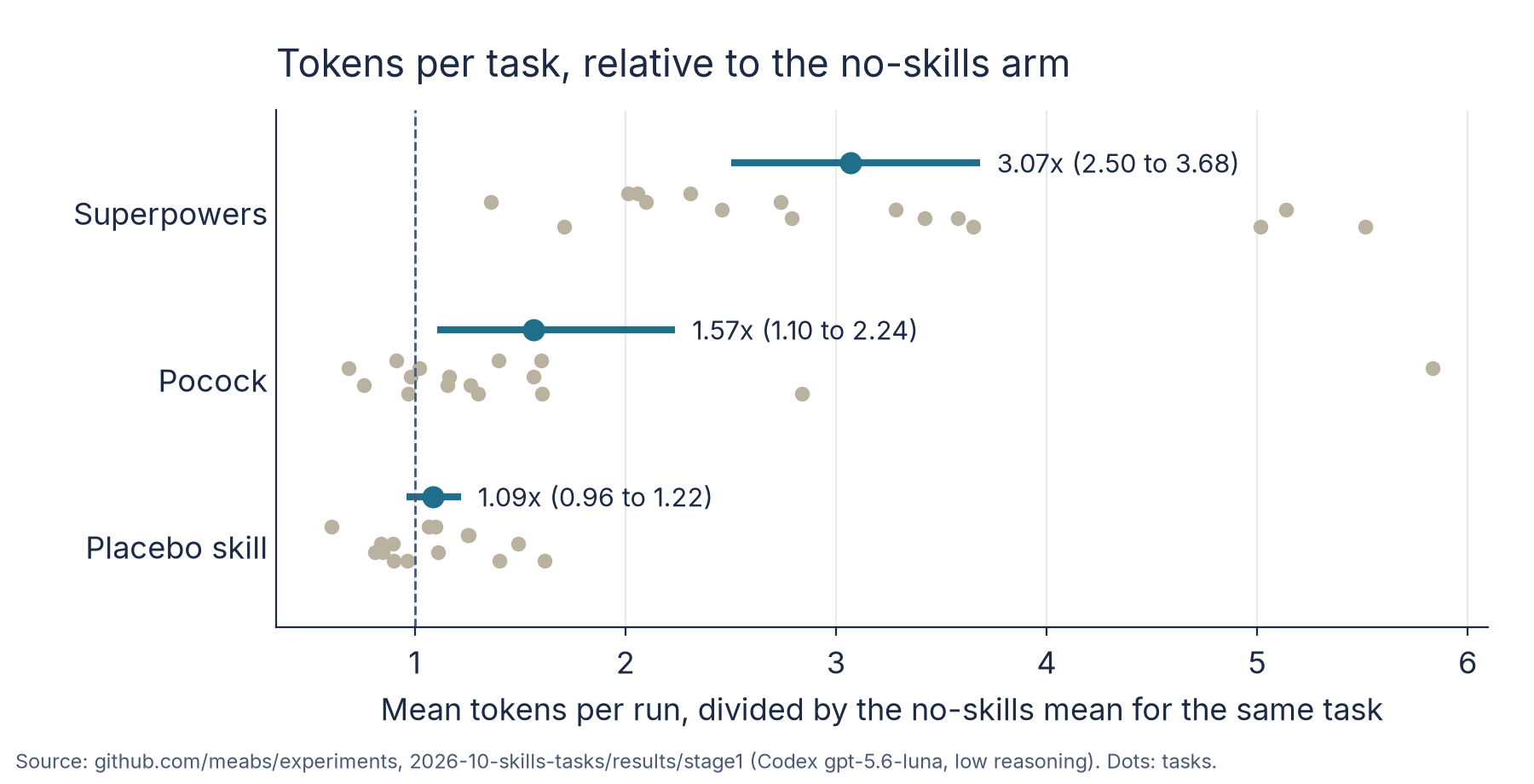
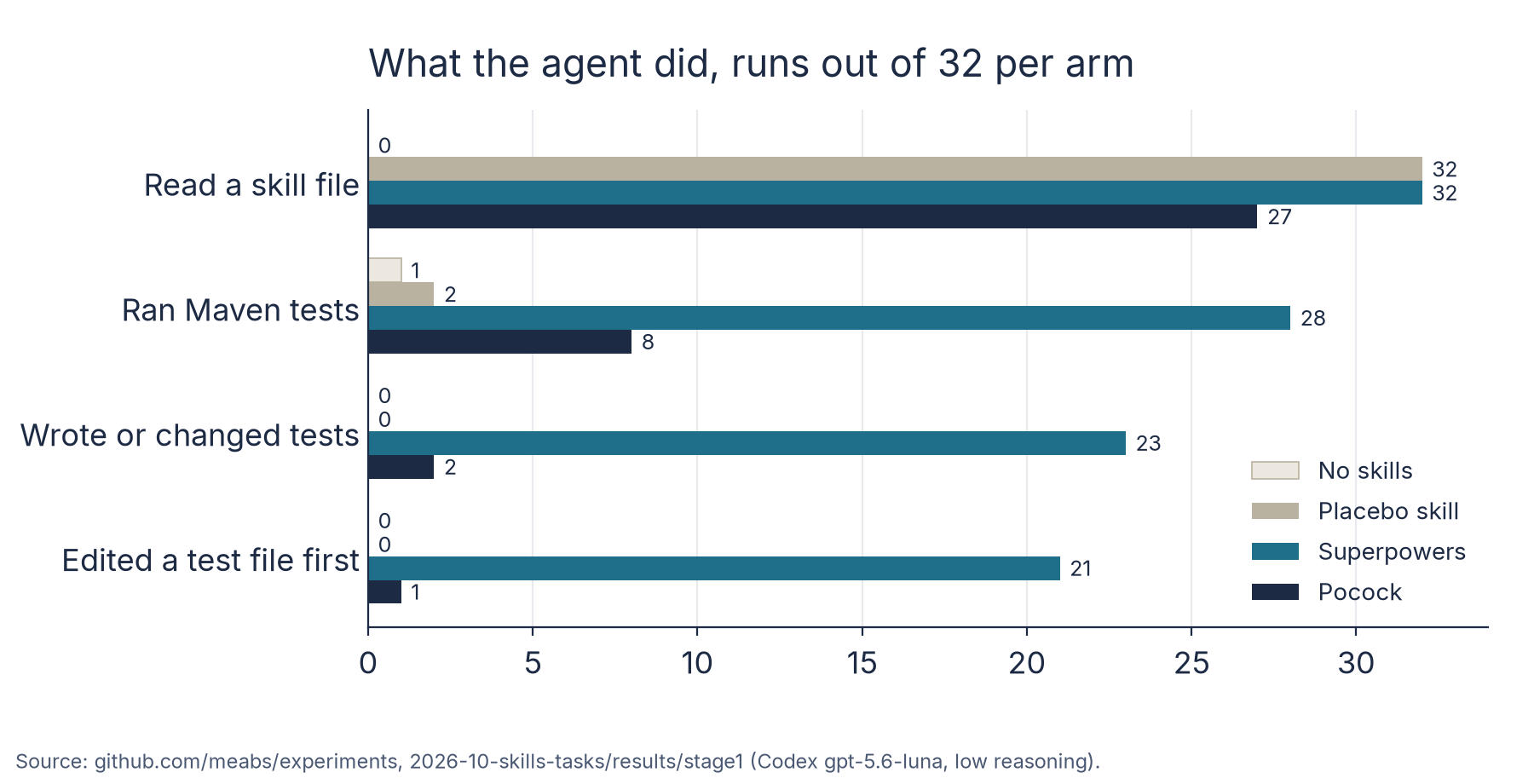
SKT-2Superpowers used about three times the tokens of no skills on the same task; it wrote tests in 23 of 32 runs, where the agent with no skills wrote none
Limitsone repository · one model at low reasoning effort
Source ↗3.07×
Interval excludes 1×
95% interval 2.50 to 3.68bootstrap 95% CI over 16 tasks
Measureper-task token ratio vs no skills
Sample64
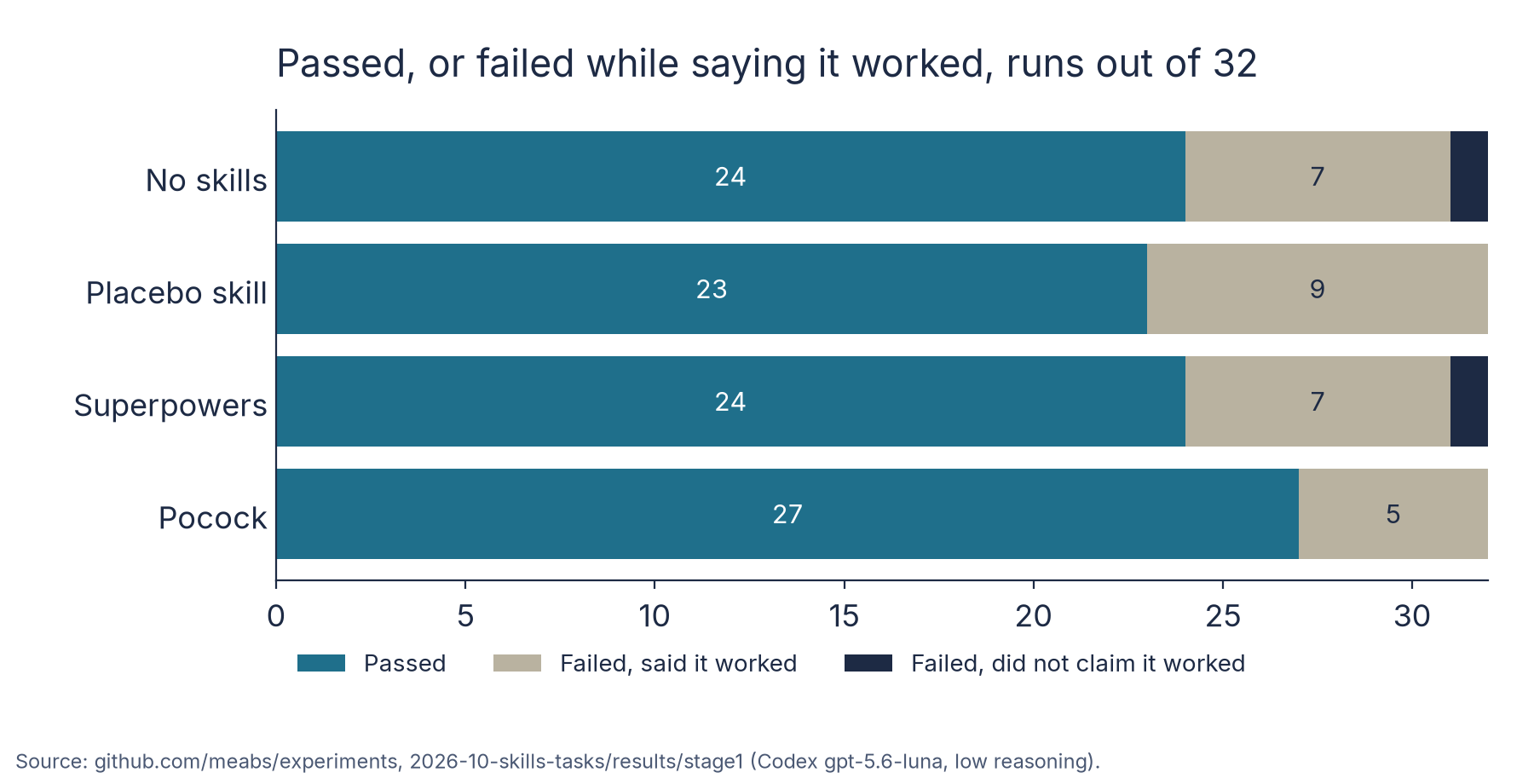
SKT-3In 28 of the 30 failed runs, the agent said its change worked; this held in every arm
Limitsthe agent could not see the hidden tests · one model at low reasoning effort
Source ↗28/30
Measurefailed runs that claimed success
Sample128
Question
Skill packs are sets of written instructions that a coding agent reads before it works: how to plan, when to write tests, how to check its own work. Two of the most widely shared are Superpowers and Matt Pocock’s skills. The question: on a varied set of real bug fixes and small features, does either pack make the agent’s changes more often correct, and what does it cost in tokens?
Prediction
Before any measured run I wrote down the design, the hypotheses, how tasks would be chosen and how the results would be compared, and published it (README.md). Fixing the plan first stops me choosing, after seeing the results, whichever comparison looks best.
The three hypotheses:
- Superpowers raises the share of runs that pass.
- Pocock’s skills raise the share of runs that pass.
- A placebo skill (described below) does not. This is a check on the other two: a pack only counts as helping if it does better than the placebo.
Set-up
The agent. OpenAI’s Codex command-line agent, model gpt-5.6-luna, set to low reasoning effort (how long the model thinks before acting). At high effort the agent solved almost every task with or without skills, which leaves nothing to measure, so I used low. Each run started from a clean configuration, so the agent could see only the skills it was meant to have.
The code. shopizer, an open-source online-shop backend written in Java: products, carts, customers, tax, reviews, served over a REST API. It is split into several modules and has its own test suite. Every run started from the same version.
Four ways of running the agent (called arms), identical except for the skills installed:
- No skills: the agent gets the task and nothing else. This is the baseline.
- Placebo skill: one skill of generic working habits, called “careful engineering” (read the request twice, map the code before changing it, and so on). It is not inert: it holds real general advice. It shows what a short, generic piece of guidance does, so a specialist pack has to beat it to show its own value.
- Superpowers: the full pack. It pushes the agent to plan, then write a failing test before changing code.
- Pocock: Matt Pocock’s pack.
The work. 16 tasks, each run twice in each arm: 16 × 4 × 2 = 128 runs. Two runs rather than one because the same agent on the same task does not always do the same thing.
The tasks
Ten are real bugs I found in shopizer by calling its API and checking the answers; one is a bug I planted; five are small features. Each task is written the way a shop owner or support team would report it (“our accountant entered a tax rate of 150 and it was accepted”), with no hint of where in the code the cause is. Some have several causes in different files.
| Task | Kind | What is wrong or wanted | Hidden tests |
|---|---|---|---|
| ADDR | Bug | A changed delivery address loses its street, and the state lands in the postal code | 2 |
| AMBIG | Bug | Fetching a category by id or by URL answers 500 | 4 |
| AVAIL | Bug | A product created as unavailable comes back available | 3 |
| CARTCALC | Planted bug | Cart line and cart totals ignore quantities | 2 |
| CATCOUNT | Feature | A category’s product count includes its subcategories, each product once | 1 |
| CATDUP | Bug | A duplicate category code answers 500 with a raw SQL error | 3 |
| CONTENT | Bug | Listing content pages without paging parameters answers 500 | 2 |
| CUSTDUP | Bug | Registering with an email already in use answers 500 | 4 |
| HCUST | Feature | Admin customer search with correct paging and totals | 4 |
| HREVIEW | Bug | Editing or deleting a review fails, and product ratings go stale (six causes) | 3 |
| MANCODE | Feature | Manufacturer code format (400) and uniqueness (409) | 4 |
| MANINUSE | Bug | Deleting a manufacturer still in use answers 503 | 3 |
| MANORDER | Feature | Store manufacturer sort order and list by it across pages | 3 |
| NOTFOUND | Bug | A missing manufacturer answers 503 and a missing product 400, not 404 | 4 |
| PAGE | Bug | The product list ignores the page asked for | 1 |
| TAXRATE | Feature | Tax rates must be 0 to 100, on create and update | 5 |
Numbers such as 400, 404, 500 and 503 are the HTTP status codes the API answers with: 4xx means the request was wrong, 5xx means the server failed.
How a run is graded
The agent never sees how it will be judged. When it finishes, a grader adds hidden tests (48 across the 16 tasks) and runs the project’s whole test suite. The hidden tests start the shop and use its API as a real client would: they send requests and check the answers and what was stored. They do not look at how the code was written, so any correct fix passes.
A run passes only if every hidden test passes and none of the project’s existing tests breaks.
For example, the TAXRATE tests create tax rates of 0, 7.5 and 100 (all must be accepted and stored), then 150, −1 and a missing rate (each must be refused with 400 and nothing stored), then try to change a stored rate of 5 to 101 (refused, and the stored rate must still be 5).
Before any run, I checked every task three ways: the hidden tests fail on the original code; they pass with my own fix, as does the rest of the suite; and for the planted bug, the existing tests still pass with the bug in place, so they give the agent no clue.
Choosing the tasks. I wrote 18 candidates and ran the no-skills agent twice on each, then kept the 16 it found hardest, by a rule fixed beforehand. Those trial runs are not counted in the results.
Results
Findings SKT-1 to SKT-3 are at the top of the page. In short:
| Arm | Runs passed | Tokens vs no skills | Average cost per run | Typical run time |
|---|---|---|---|---|
| No skills | 24 of 32 | 1.00× | $0.016 | 43 s |
| Placebo skill | 23 of 32 | 1.09× | $0.017 | 47 s |
| Superpowers | 24 of 32 | 3.07× | $0.038 | 105 s |
| Pocock | 27 of 32 | 1.57× | $0.021 | 54 s |
Costs are estimates at list prices; all 128 runs together cost about $3. Run time is the median.
How the arms were compared
The unit is the task, not the run, because some tasks are simply harder than others. For each task I took the number of passing runs in an arm (0, 1 or 2) and subtracted the number for no skills. Pocock, for example, did better than no skills on 4 tasks, worse on 1 and the same on 11.
Then the question is whether a pattern like that could easily happen by chance if the pack made no difference at all. The test I used flips the sign of each task’s difference in every possible way and counts how often the total comes out at least as large as the real one. Because two packs were tested, the result is adjusted upwards (the Holm method) so that testing more than one thing does not make a lucky result more likely.
For Pocock, the adjusted figure (the p value) is 0.38: a gap this size would turn up by chance roughly 4 times in 10. The result is inconclusive, not evidence that the pack helps, and every gain was a single run on a task. For Superpowers, the gap was zero. The 95% interval for Pocock’s gain runs from −3 to +22 percentage points: the data fit anything from a small loss to a moderate gain. So this shows no measured improvement; it does not show the packs are useless.
The comparisons have less to work with than 16 tasks suggests. Six tasks were passed by every run and one was failed by every run, so only 9 tasks separate the arms at all.
Checks added after the results
After an outside review, I added three checks that were not in the original plan. Because I chose them after seeing the data, they are leads, not results.
- Each pack against the placebo. Pocock did better than the placebo on 4 tasks and worse on none. With only 4 tasks differing, though, chance cannot be ruled out (p = 0.125 at best). Superpowers was better on 3 tasks and worse on 4.
- Cost per correct change. This charges failed runs to the arm that made them. A correct change cost $0.021 with no skills, $0.025 with Pocock and $0.051 with Superpowers. Superpowers is about 2.4 times dearer per correct change and takes about 2.3 times as long.
- Effort may matter more than skills. HREVIEW passed both of its runs at high reasoning effort when I was choosing tasks, and failed all 8 runs at low effort here, whatever the skills. Two runs against eight is a clue, not a controlled comparison.
Two tasks in detail
TAXRATE. The obvious fix is to mark the tax rate field with “must be between 0 and 100” annotations. In this code nothing checks those annotations, so they change nothing: rates of 150 were still accepted. Both no-skills runs and both placebo runs made only that fix and failed. Both Superpowers runs made it too, but also wrote a test that calls the API and added a range check in the code that refuses bad rates; one of them is confirmed to have seen its test fail before the fix. It was the only task where any arm went from 0 of 2 to 2 of 2. Testing against the running API is a plausible reason, not a proven one: the pack changed other behaviour too. On ADDR, CARTCALC and PAGE, Superpowers did worse than no skills.
HREVIEW. All eight runs failed. In seven, the change broke creating a review, which had worked before. To support editing, the agent changed shared code to look up the existing review by its id; a new review has no id yet (it is 0), so the lookup fails, and the API turns that failure into a 503. None of the project’s existing tests creates a review, so the agent’s own checks stayed green. I made the same mistake when writing my own fix. The lesson is not about skills: an agent can test the behaviour it is changing and still break a neighbouring one it never considered. Encouraging test-first work doesn’t fix that; tests that cover the shared code’s other uses would.
The other failures
| Task | Runs failed (of 8) | What the failing runs got wrong |
|---|---|---|
| ADDR | 5 | Fixed only part of a chain of copy-and-paste slips: the delivery street still came back as the billing street, and in two runs the state stayed empty |
| NOTFOUND | 3 | A missing product still answered 400 instead of 404, because the code underneath throws an error instead of returning nothing |
| CATCOUNT | 3 | A product in several subcategories was counted once per subcategory, not once |
| HCUST | 2 | Every search request answered 500: the change broke the customer list itself |
| CONTENT, CUSTDUP, PAGE, CARTCALC | 1 each | Single runs that missed one of the cases the hidden tests check |
Limits
One codebase; one agent and model; low reasoning effort only. Sixteen tasks are too few to settle a difference the size of Pocock’s: from how much the results varied between tasks, roughly 60 tasks would be needed to detect a gain of 9 points reliably. Two runs per task is coarse: the placebo, which has no specialist content, moved 4 of 16 tasks by one run. The packs were adapted to Codex, so this says nothing about how they do in their original Claude Code setting. I wrote the tasks, hidden tests and reference fixes; all are published for checking. My earlier skills-impact experiment ran the same packs on 3 tasks at high reasoning effort (162 runs). No pack raised the pass rate there either, and Superpowers also worked test-first at two to three times the tokens. Its pass rates are not comparable with these, because of the different effort setting, but the cost finding is the same.
Reproduce
Everything is in experiments/2026-10-skills-tasks: the task prompts (tasks/), hidden tests (hidden/), raw runs (results/stage1), the analysis script (scripts/analyse.py) and the chart script (scripts/charts.py). The commands are in REPORT.md, section Reproducing.
Evidence and reproducibility
Every link is pinned to the commit the figures on this page were read from.
Question, correction, or a result that differs from mine? Join the discussion ↗