Cheat sheet
Free to read on the web. October 2026 PDF · Updates
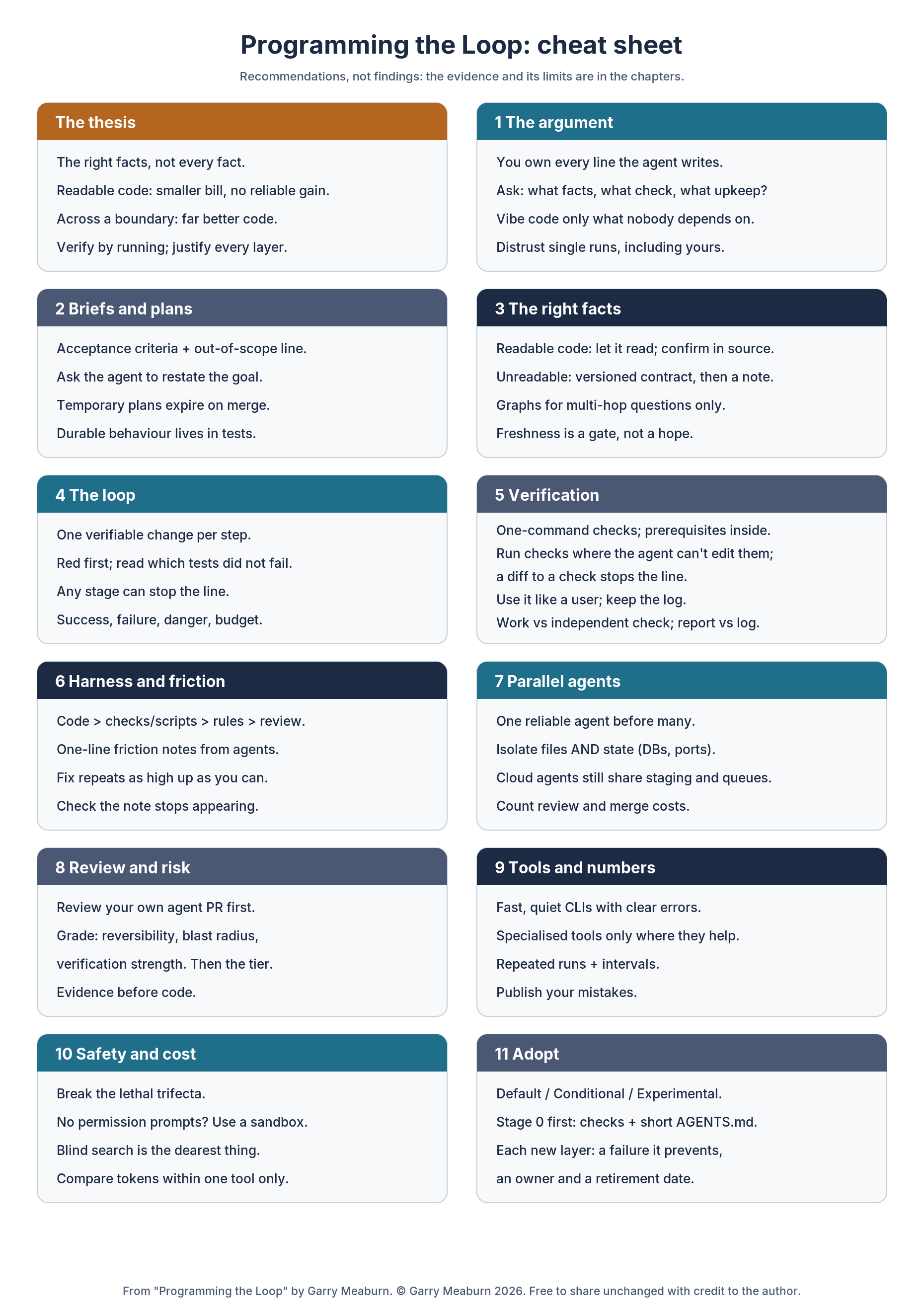
Recommendations, not findings: the evidence and its limits are in the chapters.
The thesis. Agents need the right facts, not every fact. They need executable verification, not reassuring instructions. Every layer of agent infrastructure must justify its existence. On readable code: smaller bill, no reliable difference in correctness. Across a boundary: much better code.
1 The argument. Own every line. Ask of any practice: what facts, what check, what upkeep? Distrust single runs.
2 Briefs. Acceptance criteria and an out-of-scope line. Ask for a restatement. Temporary plans expire on merge; durable behaviour lives in tests.
3 Facts. Readable code: let the agent read it, “read the source to confirm”. Unreadable dependency: versioned contract, then a short note. Graphs for multi-hop questions only. Freshness is a gate.
4 The loop. One verifiable change per step. Red first. Success, failure, danger and budget conditions.
5 Verification. One-command checks, prerequisites in the script. Run the checks where the agent can’t edit them; a diff that touches a check stops the line for human review. Use it like a user. Correctness: the work against an independent check. Honesty: the report against the command log. An honest “not run” is information.
6 Harness. Code, then checks and scripts, then rules, then review. One-line friction notes; fix repeats; check they stop.
7 Parallel. One reliable agent first. Isolate files and state. Cloud agents don’t isolate external databases, staging or queues.
8 Review. Grade by reversibility, blast radius and verification strength. Evidence before code.
9 Tools. Fast, quiet CLIs with clear errors. Measure with repeated runs and intervals.
10 Safety and cost. Break the lethal trifecta. Sandbox if you skip prompts. Blind search is the dearest thing an agent does.
11 Adopt. Default, Conditional, Experimental. Stage 0 first. Every new layer needs a failure it prevents and a retirement date.